
How to build an unsurfaced track system: a short guide
The concept paddock paradise, also known as a track system, was created by Jaime Jackson after his research on the wild and free-roaming horses of the US Great Basin. It’s purpose is to optimise overall health both mentally and physically, mimicking the environment, behaviours and foraging patterns of horses in their adaptive environment.
Beginning the build of your track system can feel overwhelming, and many owners don’t know where to start. Here is a short and sweet step-by-step guide to get you going!
Before we start, if you haven’t read the original book, go no further. Jaime Jackson’s Paddock Paradise book is essential to understanding why this concept came to be and exactly why it works. Track systems require much more than fencing and a nice layout to work, so understanding how to set your horses up for success from day 1 is vital.
Now, back to it.
1) Study your land
This is an important first step that most owners tend to skip. However, it’s crucial to have a somewhat thorough understanding of how your land behaves across different seasons, particularly if you are unable to surface your track system. You’ll want to take note of naturally boggy areas, places that provide wind breaks, natural shelter, consistently ‘dry’ areas and anywhere that allows access to your track or land. Once you understand how your land behaves, you can avoid making mistakes that may mean refencing or repairs later down the road.
2) Draw out your design
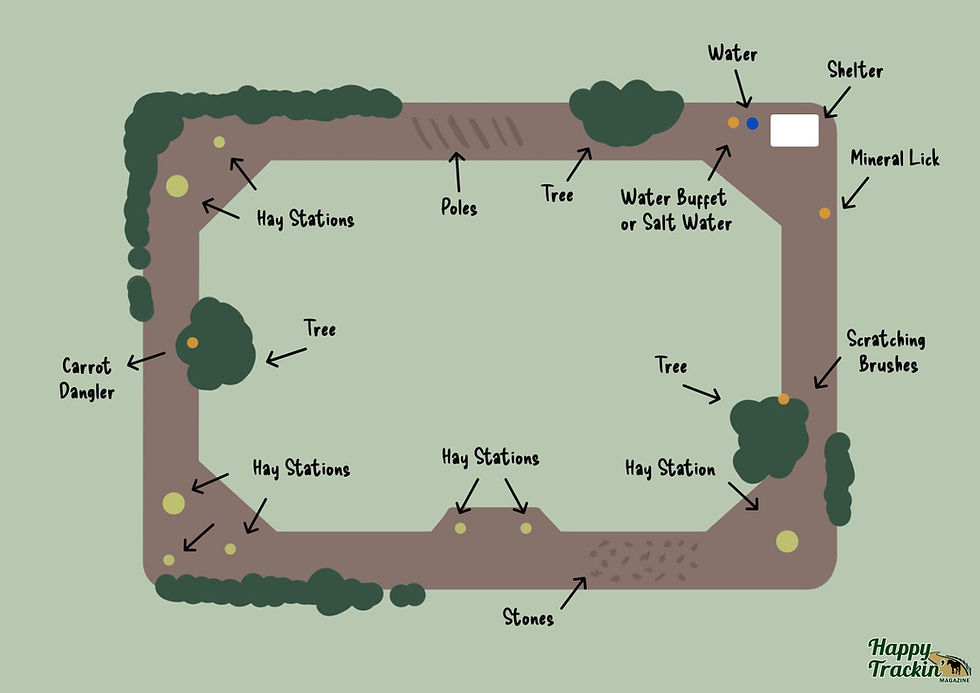
Going onto Google Earth and screen shotting your plot of land is one of the easiest ways to start drawing out a rough layout. Within this design, you need to include the basics:
Hay stations
Where you put your hay stations is probably the most important step to building a track system. You’ll need to consider if your hay stations will provide enough room for your horses to move safely, whether you need to accommodate any horses with resource guarding issues and anxiety around forage, the size of your hay stations and much hay you’d like to feed in one area and where your hay stations are in proximity to your water. Remember, we want to encourage movement, not camping!

You should also consider the herd you're building your track for. This will also influence how you place your hay stations, and whether you'd like clusters of smaller or differing hay sources in one area for a larger herd, or a herd that likes to eat within sight of one another. Smaller hay nets but more hay sources are also more likely to encourage movement as opposed to large hay bales and less hay sources.

One area for water, if you can
Your water should be furthest away from your hay stations. Ideally, if you have a pond, place your fresh water source close by. Two water sources spread out can reduce the movement we want to see achieved day to day.
Shelter, natural or built
This is the perfect time to utilise trees, hedges and natural dips in your land to provide a variety of different shelter options. If you have a man-made shelter, I would recommend placing this somewhere you know your horses already like to stand or sleep. However, I do not recommend putting a hay station anywhere near your shelter, if you can help it.
Loafing areas
Loafing areas should ideally be places your horses already choose to sleep, stand and play. There is no point building a designated loafing area if your horses don’t like it! Factor in the size of your herd when deciding how big your loafing areas should be.
Access points
Consider how you'll access your track system with machinery or vehicles, and how you'll get your horses off track too. This would also be a good time to think about whether you'd like feeding pens accessible off track, or a yard/storage area etc.
Width
Take care when planning your track system’s width. Too much space and your horse’s will most likely camp but too little space, and you could have an anxious herd.
My recommendation is to form your track’s width on 1 meter per horse and widen any areas you know you’ll be feeding hay. Remember, narrow tracks should promote movement through them whilst wider areas should allow space for eating, sleeping and standing without anxiety.
However, if need vehicles or certain machinery to access or travel along your track, then you will also need to take this into consideration. An alterative to this could be building in access points to areas you know you'll need frequent access to, such as hay stations, and travelling along the outside of the track instead.
Additionally, make sure to round your corners. This removes any 90 degree bends that could potentially cause issues to horses moving around the track at speed, or machinery that needs to move around with ease. This also automatically makes for larger areas that you could utilise as loafing areas or hay stations.
Lastly, footfall is the easiest way to get rid of unwanted grass on your track system. If your track system is too wide for your herd, you will struggle to keep the grass away.
3) Start with temporary fencing
As annoying as it may be to fence twice, using temporary fencing allows you to set up your track system and observe where it does and doesn’t quite work. I typically recommend doing this for as long as you can, so you have an idea of how your track works through all the seasons.
Temporary fencing will allow you to make easy changes without additional money or resources being wasted. You’ll get an idea of:
Whether your track width works to encourage movement or stagnation
Areas of land that haven’t weathered well
Parts of your track system that your horses do not like
Problematic areas for the herd or individual horse
Any layout changes that would benefit your herd
Whether you need to add, move or change your hay stations
Once you have a basic idea of how your horses do on your temporary track system, you can start making those all important changes, be that for your horse or yourself.
A well functioning, successful track system works for both owner and horse.
4) Make your all-important changes and have fun!
This is where you can really start to make your track your own, and correct any mistakes you have made with your temporary track. You can also start replacing your temporary fencing with longer lasting, sturdier materials. Want some help building your perfect fence? Check out Julian's Top Tips in Issues 3, 7 and 8. If you're in need of some mud control tips, check out Issue 4.
This is also where you can begin adding enrichment onto your track system. Enrichment provides other things to do on track, in addition to foraging, which can be particularly helpful in increasing movement and reducing camping at hay stations. Of course, they are also incredibly important to our horses' mental health which is a key part in using track systems.
Here are two examples of our biggest track systems over at PB Paddock Paradise Livery.


Comments